Introduction
John Delpratt was interested in finding the best way to harvest seed from Bulbine bulbosa – a perennial lily native to grassland in southern and eastern Australia. Hand harvesting the seed is difficult and time-consuming, and seeds are easily lost.
John compared the traditional method of hand–collecting seeds from open fruit with three different methods of harvesting and ripening fruit in an artificial environment.
The key issues John wanted to address were:
Did the harvesting method influence seed yield and seed size?
Timeline
- Spring 1996
- December 1996
-
Data collection starts
- February 1997
-
Data collection finishes
- Summer 1997
-
Data analysis starts
- July 1999
-
Final report
Background
Harvesting seeds from bulbine bulbosa
Bulbine bulbosa is a perennial lily native to grasslands in eastern and southern Australia. It has grass-like leaves growing from a compressed stem or bulb. In the wild, it produces leaves in autumn, followed in spring by one or more unbranched flowering stems. In cultivation, mature fruit produces from one to thirteen black, angular seeds. The fruit matures sequentially from the base of the stem. Usually, one to three fruits open on a stem in one day. It is common for shedding fruit, immature fruit, two or three open flowers and unopened buds to be present on the one stem at one time.
Harvesting seed efficiently from Bulbine bulbosa is difficult. Once each fruit opens, the seed is easily dislodged. A high recovery of mature seeds can be achieved by hand harvesting fruit every one to three days just before their opening and shedding their seed. But hand harvesting is tedious and time-consuming.
An alternative may be to harvest intact stems, allow them to dry, and recover the seed when it falls from the dried fruit. Although fewer seeds might be collected using the alternative method, the method might still be worthwhile because of the savings in time.
With the range of reproductive stages up a given stem, it was not obvious when to harvest each stem, nor to what extent the seed would continue to develop and mature once a stem was cut from the plant and allowed to dry. The experiment investigated the influence of the harvest method of Bulbine bulbosa on total seed yield and seed size. The conventional hand harvesting method, where stems remained on the plant and fruits were harvested as they reached harvest maturity, was compared to storing harvested stems in a controlled environment.
Objective
To investigate the influence of harvest method of Bulbine bulbosa on seed yield and seed size.
Harvest treatments
Bulbine bulbosa plants were grown to maturity in standard nursery containers, one plant to a container. In December 1996, plants were selected. The selection criteria were that each plant had at least one stem that had set twenty or more fruit and that the oldest (lowest) fruit on that stem was approaching harvest maturity. Plants were randomly allocated to one of four treatments, with ten plants in each treatment.
The four treatments
- Fruit was harvested as each reached harvest maturity (hand harvest)
- Stems were harvested when the first fruit was at harvest maturity (early harvest)
- Stems were harvested when the third fruit reached harvest maturity (intermediate harvest)
- Stems were harvested when the sixth fruit reached harvest maturity (late harvest).
The plants were placed on a nursery trolley in a completely randomised arrangement and hand-watered for the duration of the experiment.
For treatment 1, each fruit was hand-harvested as it reached harvest maturity. For stems in treatments 2, 3 and 4, the first, the first three and the first six fruit, respectively, were not counted as part of the harvest.
However, the seeds from these fruits were collected and counted as they represented seeds lost from the harvest for these treatments.
At harvest commencement, the following information was recorded for each stem:
- Number of fruit aborted
- Number of fruit (including those that will be discarded in treatments 2, 3 & 4)
- Number of open flowers
- Number of unopened buds
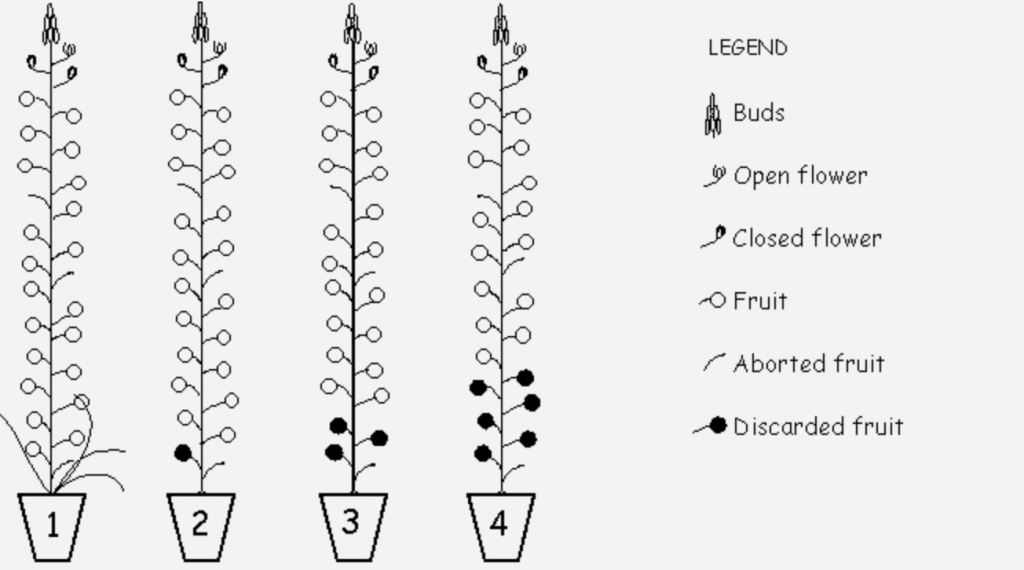
The figure by Lynn Heath shows Bulbine bulbosa stems harvested left intact (treatment 1) or harvested at three maturities (treatments 2,3 and 4). Fruit depicted as solid were discarded from the harvest count.
For stems in treatment 1, all open flowers and buds were retained on the stem and were allowed to develop normally, as would be the case in a sequential, nondestructive harvest.
For stems in treatments 2, 3 and 4, all unopened buds above the topmost open flower were removed at harvest.
While this differed from the method for treatment 1, the buds were removed on the assumption and prior observation that they would not set fruit once detached from the plant.
Harvested stems were tied to bamboo stakes with a twist tie. This arrangement kept the stems straight and stable. They were placed upright in a controlled environment cabinet set at 20oC, with 16 hours of light and 8 hours of darkness in each 24-hour cycle. The stems were placed upright to allow for the analysis of the seed yield of each fruit at harvest maturity. In practice, it is likely that detached stems would be dried in bunches and held upside-down, with the seed falling into a collector as the fruit opened.
As fruits reached harvest maturity, they were removed from the stem. Harvested seeds were stored in paper envelopes.
Seeds were screened into three category sizes using 2mm, 1.5mm and 1.2mm sieves. Large seeds were those retained by the 2mm sieve. Medium size seeds were those retained by the 1.5mm sieve, and small seeds were retained by the 1.2mm sieve. Seeds passing through the 1.2mm were essentially undeveloped and were disregarded; these seeds are irrelevant and were not counted in the variable ‘Number of discarded seeds’.
Study design
Statistician’s description of study design
John’s study used four independent groups corresponding to four harvesting methods. It was a completely randomised design: there was no blocking.
Variables measured at harvest commencement
- Number of fruit at harvest commencement
- Number of open flowers
- Number of unopened buds
Variables measured at harvest completion
- Number of fruit harvested
- Number of seeds from harvested fruit
- Number of fruit discarded
- Number of seeds discarded
- Harvest duration in days
John talks about the study design
Protocol
| Plant selection | Grow plants to maturity, one per standard nursery container. Selection criteria – plants with twenty or more fruit and the oldest (lowest) fruit is approaching harvest maturity. Select 40 plants. |
|---|---|
| Treatment allocation | Randomly allocate plants to treatments, 10 plants per treatment. |
| Plant maintenance | Store plants on a nursery trolley, randomly distributed; hand water for the duration of the experiment. |
| Identifying start of harvest | Hand harvest (T1) – when 1st fruit reaches harvest maturity Early harvest (T2) – when 1st fruit reaches harvest maturity Intermediate harvest (T3) – when 3rd fruit reaches harvest maturity Late harvest (T4) – when 6th fruit reaches harvest maturity |
| Harvesting – hand harvest treatment | T1: Hand-harvest each fruit as it reaches harvest maturity. Retain all open flowers and buds on the plant; allow to develop normally. |
| Harvesting – early, intermediate & late harvest treatments | T2, T3 & T4: the 1st, the 1st 3 and the 1st 6 fruit respectively, are not counted as part of the harvest. Collect seeds from these fruit. Remove all unopened buds above the topmost open flower. |
| Data to record at harvest commencement | For each plant, record the number of: fruit aborted; fruit set, including those that will be discarded in treatments 2, 3 & 4; open flowers; unopened buds. |
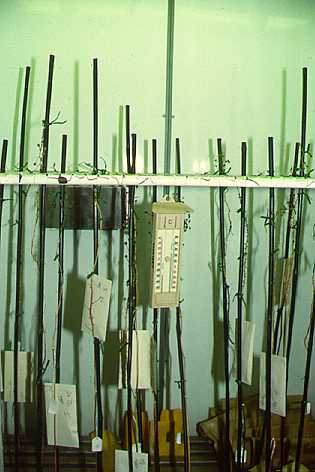
The photograph by John Delpratt shows the controlled maturation environment.
Summary
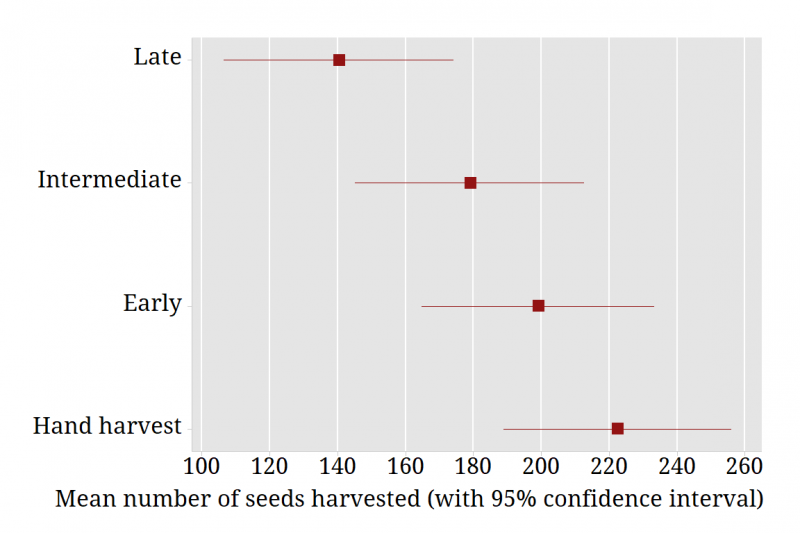
John found that there was a viable alternative to the traditional method of hand harvesting seeds from Bulbine bulbosa. Overall, yields for alternative harvesting methods were lower than the traditional method and yields decreased as the alternative harvest time got later. However, the yield from early harvesting method was not substantially lower than the hand method; of the three methods investigated, it is the best alternative to hand harvesting.
This figure shows 95% confidence intervals for mean seed yield adjusted for number of fruit at harvest commencement.
Questions to consider
- Produce a graphical display to illustrate the seed yield using the different methods of harvesting.
- Produce a graphical display to show the seed sizes for different harvesting methods.
- Does the seed yield vary according to the method of harvesting?
- Are there other plant characteristics that you should consider in assessing seed yield?
- Does the effect of harvesting on seed yield change when you take other plant characteristics into account?
- What is the likely yield for each harvest method? Give a confidence interval for each method.
- Does the method of harvesting influence the duration of harvest? Provide a graphical display to show which method is most time-consuming.
- Does the method of harvesting affect the size of the seeds?
- Write a short report indicating which method(s) of harvesting you would recommend. Include some graphs to support your recommendation.
Definitions of variables in data file
| Column | Variable label | Definition |
|---|---|---|
| C1 | Type of harvest | Type of harvesting method used |
| C2 | Plant number | Plant number within each harvesting method |
| C3 | Number of fruit harvest start | The number of fruit on the plant at harvest commencement |
| C4 | Number of flowers harvest start | The number of flowers on the plant at harvest commencement |
| C5 | Number of buds harvest start | The number of buds on the plant at harvest commencement |
| C6 | Number of fruit harvested | The number of fruit harvested |
| C7 | Number of seeds from harvested | The number of seeds obtained from the harvested fruit |
| C8 | Number of discarded fruit | Number of discarded fruit |
| C9 | Number of discarded seeds | The number of seeds obtained from the fruit that was discarded |
| C10 | Harvest duration in days | How long the harvest took in days |
| C11 | Number of large seeds | Number of seeds over 2mm in length |
| C12 | Number of medium seeds | Number of seeds between 1.5mm and 2mm in length |
| C13 | Number of small seeds | Number of seeds between 1.2mm and 1.5mm in length |
| C14 | Seeds per fruit | Number of seeds per fruit harvested |