Study design
Statistician’s description of study design
John’s study used four independent groups corresponding to four harvesting methods. It was a completely randomised design: there was no blocking.
Variables measured at harvest commencement
- Number of fruit at harvest commencement
- Number of open flowers
- Number of unopened buds
Variables measured at harvest completion
- Number of fruit harvested
- Number of seeds from harvested fruit
- Number of fruit discarded
- Number of seeds discarded
- Harvest duration in days
John talks about the study design
Protocol
| Plant selection | Grow plants to maturity, one per standard nursery container. Selection criteria – plants with twenty or more fruit and the oldest (lowest) fruit is approaching harvest maturity. Select 40 plants. |
|---|---|
| Treatment allocation | Randomly allocate plants to treatments, 10 plants per treatment. |
| Plant maintenance | Store plants on a nursery trolley, randomly distributed; hand water for the duration of the experiment. |
| Identifying start of harvest | Hand harvest (T1) – when 1st fruit reaches harvest maturity Early harvest (T2) – when 1st fruit reaches harvest maturity Intermediate harvest (T3) – when 3rd fruit reaches harvest maturity Late harvest (T4) – when 6th fruit reaches harvest maturity |
| Harvesting – hand harvest treatment | T1: Hand-harvest each fruit as it reaches harvest maturity. Retain all open flowers and buds on the plant; allow to develop normally. |
| Harvesting – early, intermediate & late harvest treatments | T2, T3 & T4: the 1st, the 1st 3 and the 1st 6 fruit respectively, are not counted as part of the harvest. Collect seeds from these fruit. Remove all unopened buds above the topmost open flower. |
| Data to record at harvest commencement | For each plant, record the number of: fruit aborted; fruit set, including those that will be discarded in treatments 2, 3 & 4; open flowers; unopened buds. |
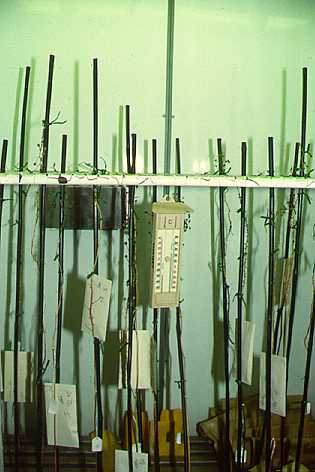
The photograph by John Delpratt shows the controlled maturation environment.