Study Design
Interventions
- Control treatment
- Music therapy
Variables measured
Immediately before treatment
- Heart rate
- Ratings of 9 symptoms on the Edmonton Symptom Assessment System
- Behavioural Observation Checklist
Immediately after treatment
- Heart rate
- Ratings of 9 symptoms on the Edmonton Symptom Assessment System
- Behavioural Observation Checklist

Other information recorded
- Gender
- Eastern Cooperative Oncology Group performance status
- Duration of treatment
Statistician’s description of the design
The study was a randomised controlled trial. Terminally ill patients were randomly assigned to receive a standard intervention or music therapy.
Calculating the power of the study
When planning the study, Anne thought it was feasible to obtain 30 patients in her control group and 30 patients in her music therapy group. The power of detecting various differences between the two groups was based on 30 participants in each.
Anne hoped to find a greater change in anxiety in the music therapy group compared with the control group. Her primary outcome of interest was the change in anxiety measured by the Edmonton Symptom Assessment System (ESAS) from before to after an intervention. To estimate the power, an estimate of the standard deviation of the change in ESAS anxiety score was needed. Some previous research on patients in palliative care had reported the standard deviation of the ESAS anxiety on two occasions – the first was 2.9cm, and the second was 2.8cm. Another study reported that the correlation of ESAS anxiety measured 1 day apart was 0.62. Together, this information was used to estimate the standard deviation of ESAS change score as 2.5cm.
The table below shows the power for various average differences between the groups; the power for detecting an average difference of 1cm, for example, is 0.33. The average confidence interval width for the mean difference between the groups is 2.6, if the sample size is 30 in each group and if the standard deviation of the ESAS change score is 2.5cm. Of course, the confidence interval in the actual study will be subject to random variation and will have a slightly different location and width.
| True average difference between groups in anxiety change | Power |
|---|---|
| 0.5 | 0.12 |
| 1.0 | 0.33 |
| 1.5 | 0.63 |
| 1.8 | 0.78 |
| 2.0 | 0.86 |
| 2.5 | 0.97 |
These illustrative calculations are based on the correlation between the two measurements of ESAS anxiety scores (before and after the intervention) being about 0.6. This estimate of the correlation came from a study where ESAS anxiety was measured 1 day apart. Anne planned to measure anxiety twice within two hours, so it was possible that the correlation between the two measurements would be higher than 0.6.
Randomisation procedure
A statistician prepared a randomisation list. Sixty patients were randomised to either the control or music therapy groups in (six) blocks of ten. The randomisation procedure ensured that there were five patients assigned to each treatment in each block.
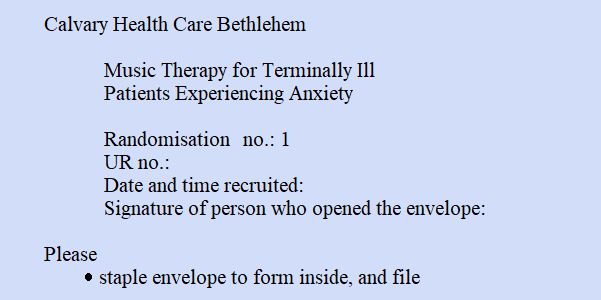
The statistician prepared 60 envelopes providing the randomisation for each of 60 patients. Each envelope was numbered from 1 to 60; the randomisation was inside. The envelopes were kept at the hospital where the study was being conducted. When the first patient had been recruited to the study, the first envelope was opened; when the second patient was recruited, the second was opened, and so on. Anne or another music therapist involved in the study opened the envelope.
Data collection
Protocol
| Patient identification | Terminally ill patients aged between 18 and 90 years of age receiving palliative care at Calvary Health Care Bethlehem were included in the study. Patients were eligible if they were referred to the hospital’s music therapists for treatment of their anxiety. |
|---|---|
| Exclusion criteria | Potential participants were excluded if they: (a) were unable to speak English, (b) had a major hearing impairment, or (c) scored more than 10 on the Blessed Orientation, Memory and Cognition instrument. This includes a series of simple tasks such as counting backwards, saying the months backwards and asking about orientation to time; people scoring more than 10 are regarded as cognitively impaired. |
| Patient recruitment | Anne did not recruit the patients. They were invited to participate by other staff members, and given a plain language explanation of the study. The study was described as assessing the effects of music therapy and volunteer and other services in the hospital on peoples’ symptoms. Patients were given about 30 minutes to consider participating. |
| Informed consent | Patients agreeing to participate were asked to sign an Informed Consent form. |
| Refusal to participate | If the patient did not wish to participate, he or she was offered music therapy and visits by volunteers. |
| Assignment to treatments | When the consent form was completed, Anne (or another music therapist assisting with the study) opened the relevant randomisation envelope (the first envelope for the first patient recruited, the second envelope for the second patient recruited, and so on). A treatment session was then arranged. |
| Data collection prior to the intervention | Three sets of data were collected by a staff member who was not involved in the study. This included measuring heart rate, filling in the Behavioural Observation Checklist, and assisting the patient with completing the Edmonton Symptom Assessment Scale. Prior to the intervention, Anne or another music therapist recorded demographic and medical information about the patient and completed the Eastern Cooperative Oncology Group performance status. |
| Music therapy | Therapy sessions were held one-on-one in the patient’s room. Anne or one of the other hospital music therapists used a range of music therapy techniques to reduce anxiety. |
| Standard therapy | Sessions with a volunteer were held one-on-one in the patient’s room. |
| Data collection post-intervention | Data were collected by the same staff member who collected the pre-intervention information. Again heart rate was measured, the Behavioural Observation Checklist was completed, and the Edmonton Symptom Assessment Scale was filled in. |
Reference
A paper about the Blessed Orientation, Memory and Cognition instrument:
Katzman, R., Brown, T., Fuld, P., Schechter, R., & Schimmel, H. (1983). Validation of a short Orientation-Memory-Concentration Test of cognitive impairment. American Journal of Psychiatry, 140(6), 734-739.