Study design
Ethics
Hear discussion with Lesley Day about potential ethical issues in both designing and conducting the study by watching the video.
Variables
-
- Age
- Gender
- Marital status
- Living alone (yes or no)
- Post high school education
- Fall in the last month (yes or no)
- Activities of daily living
- Use of support services
- Falls efficacy scale
- Number of medications taken
-
- Quadriceps strength (left and right)
- Postural sway in bare feet
- Postural sway on foam mat
- Maximal balance range
- Number of errors on dynamic balance test
- Timed-up-and-go test (time to complete test)
- Single leg balance (left and right)
- Low contrast acuity (left and right eye)
- High contrast acuity (left and right eye)
- Presence of stereopsis
- Field of view
- Total number of home hazards
- Height (cms)
- Weight (kg)
-
- Exercise intervention
- Vision intervention
- Home hazard intervention
-
- Self-reported falls (time to nth fall)
A fall was an accident where balance was lost and part or all of the body hit the ground.
Structured telephone interview:
- Circumstances of fall
- Details of what happened during the fall
- Injuries from fall
- Care sought as a result of the fall
-
- Activities of daily living
- Use of support services
- Falls efficacy scale
- Number of medications taken
- General practitioner visits
- Hospital admissions
- Quadriceps strength (left and right)
- Postural sway in bare feet
- Postural sway on foam mat
- Maximal balance range
- Number of errors on dynamic balance test
- Timed-up-and-go test (time to complete test)
- Single leg balance (left and right)
- Low contrast acuity (left and right eye)
- High contrast acuity (left and right eye)
- Presence of stereopsis
- Field of view
- Total number of home hazards
Statistician’s description of the design
The study was a randomised controlled trial that examined the effectiveness of three interventions in reducing falls among the elderly.
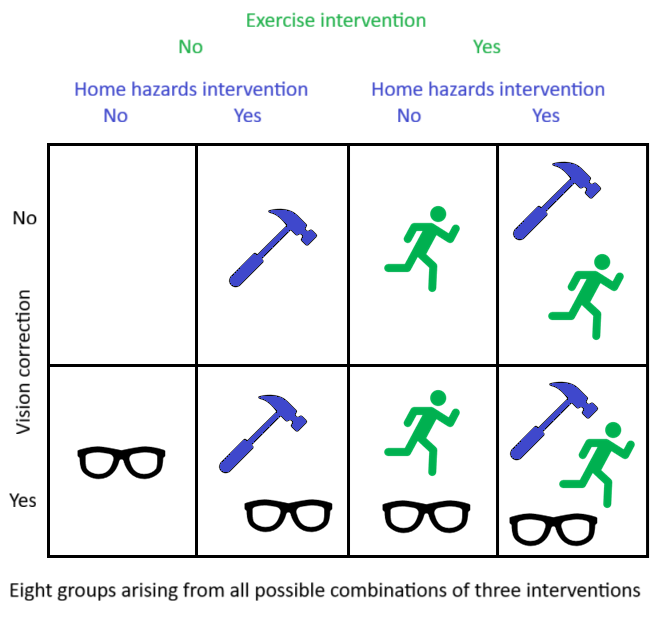
It was a full factorial design with three factors – exercise, vision improvement and home hazard reduction – each with two levels. Hence, the trial included 8 independent groups.
Computer software was used to assign each participant randomly to one of the eight groups.
Planning of the trial involved estimating the number of participants required, described further below.
Calculating the sample size for the study
An estimate of the sample size needed was calculated in the following way:
- The annual rate of falls if there was no intervention was assumed to be 35 falls / 100 people. This figure was based on recent data.
- It was assumed that any one intervention alone would reduce the rate of falls by 25%. Therefore, for the intervention group, the rate of falls would be 26 falls / 100 people.
- It was assumed that there is interest in detecting both positive and negative changes in the intervention group. Sample size calculations were based on a two-sided test.
- The significance level was set at 5%.
- The power – the probability of detecting a true difference between the control and intervention group – was set at 0.80.
- Using the assumptions above, 914 participants were required.
- It was assumed that 20% of those who initially agreed to participate would drop out.
- Hence, the final sample size required is 1143, since 914 = 80% of 1143.
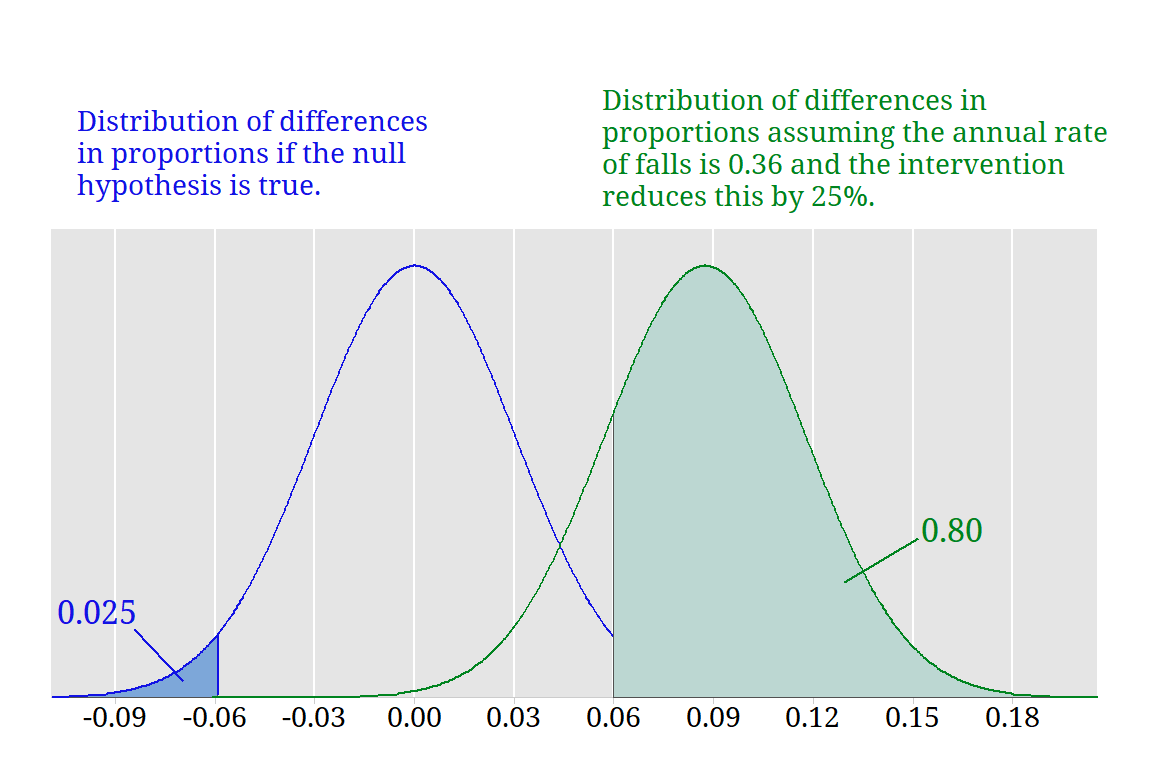
The figure shows sampling distributions of the difference in proportions between the control and intervention group with equal sample sizes of 457. The blue distribution is the sampling distribution when the true proportions in the experimental and control groups are equal. The green distribution is the sampling distribution of differences in proportion when the intervention reduces the annual rate by 25%.
Randomisation procedure
As participants were recruited into the study, they were randomly assigned to one of the eight treatment groups. Hence, entry to the study was “staggered” and there was potential for imbalance in the number of participants assigned to the eight groups. This is particularly a problem if the number of participants is small.
The randomisation procedure used attempted to adjust for this potential imbalance. The computer software used produced randomisation charts following an adaptive biased coin procedure. The adaptive biased coin procedure adjusts the probability of assignment to group i at any given time according to the degree of imbalance in the current group assignments, giving slightly higher probabilities of allocation to groups with disproportionately low numbers.
Sample randomisation chart
| Number of treatment groups | 8 |
|---|---|
| Total number of subjects | 60 |
| This chart commenced at subject number | 46 |
| Treatment | Previous tally | Cumulative tally in this chart |
|---|---|---|
| Control | 5 | 7 |
| Home modification | 6 | 8 |
| Exercise | 5 | 7 |
| Vision | 5 | 7 |
| Home modifications and Exercise | 6 | 7 |
| Home modifications and vision | 6 | 8 |
| Exercise and vision | 6 | 7 |
| Home modifications, exercise and vision | 6 | 9 |
References on the randomisation procedure
Lachin, J.M. (1988) Statistical properties of randomization in clinical trials. Controlled Clinical Trials, 9, 289-311.
Wei, L.J. (1978) The adaptive biased-coin design for sequential experiments. Annals of Statistics, 6, 92-100.
Wei, L.J. & Lachin, J.M. (1988) Properties of urn randomization in clinical trials. Controlled Clinical Trials, 9, 345-364.
Data collection
-
Advertisements Local papers, community radio, channel 31 Posters & brochures (multilingual) Service and Probus clubs, Neighborhood houses, Community centres, Home care, Meals on wheels Presentations Senior citizens organisations, Social clubs Displays Shopping centres Personal contact General practitioners, Physiotherapists, Hospital staff Participant recruitment Sampling frame Identify all people over 70 years old listed on the Australian Electoral Roll in the City of Whitehorse. Recruitment Send recruitment letter to all those identified as eligible from the Electoral Roll. Non-respondents are followed up with a telephone call to explain the study and invite them to participate.
-
Initial screening Ask potential participants initial screening questions on first telephone contact. Inclusion criterion Potential participants should be living in own home or in rented accommodation where home hazards could be modified. Participation in the study is approved by the potential participant’s general practitioner.
Exclusion criteria Exclude any potential participant who: - has a partner living in same home already in the study
- anticipates moving from the area within two years
- has participated in an exercise program similar to the exercise intervention in the last 2 months
- cannot walk 10-20 metres without rest
- cannot walk 10-20 metres without assistance
- cannot walk 10-20 metres without experiencing angina
- has respiratory disease
- has cardiac disease
- had psychiatric illness that prevents participation in interventions
- has dysphasia (a speech impairment)
- has recent modifications to home
- fails the Short Portable Mental Status Questionnaire (a measure of organic brain problems)
-
Assessors A trained assessor makes a home visit to collect background information and assess risk factors. The assessor does not know which intervention(s) the participant will receive, because the random allocation to treatment group has not yet occurred. Questionnaire Home assessor interviews participant to complete background and risk factor questionnaires. Measures include a Falls Efficacy Scale which gives a quantitative measure of the fear of falling during activities of daily living. -
Quadriceps strength Participant should be seated. Attach spring gauge to one ankle. Record quadriceps strength in kilograms while leg is extended. Repeat three times, and record the best result. Repeat the procedure for the other leg. Postural sway Measure postural sway using the Lord swaymeter under two conditions: (i) in bare feet, and (ii) standing on 8.5cm thick foam pad. Attach the swaymeter belt to the participant’s waist. The rod connected to the belt should be behind the participant. The belt is connected by the rod to a pen. Ensure that the pen and graph paper are placed on a stable surface. The participant’s body movement should be traced on the graph paper by the pen. Maximal balance range Again use the Lord swaymeter with the rod behind the participant. Ask the participant to lean backwards and forwards. The participant should attempt to go as far as possible without losing balance. The test should be attempted three times and the best result recorded. Record the distance travelled by the swaymeter pen for the best attempt. Dynamic balance Use the Lord swaymeter with the rod in front of the participant. Show the participant the pattern to be traced on the swaymeter graph paper. The participant should keep both feet on the ground while moving his or her body to follow the pattern. Record the number of times the pen moves outside the track to be traced, and add 5 every time a corner is cut. Timed-up-and-go test Seat the participant in a chair without arm rests. Ask the participant to get up from the chair, walk three metres, turn around, walk back to the chair and sit down. Record the time taken in seconds. Single leg balance The participant should remove his or her shoes. Ask the participant to balance on one leg without any supports for one minute. Record the time in seconds that the participant is able to balance on one leg. Repeat for the other leg. Height Measure participant’s height (shoes removed) in cm. Weight Measure participant’s weight in kg. Visual acuity: Conduct visual acuity tests in the best lit room in the participant’s home. Open all curtains and turn on all lights. Low & high contrast charts Seat participant two metres from test charts. First use low contrast version of standard letter chart. Cover one eye and ask participant to read chart starting from the line with the largest letters. Record the smallest line the participant could read correctly (entirely or in part). Repeat for other eye. Second use high contrast version of standard letter chart and repeat the test. Random dot stereo butterfly chart 1. Ask participant to identify (butterfly) pattern in random dots. 2. Present participant with depth discrimination cards, one at a time, from easiest to most difficult. Each depth discrimination card shows four circles. Ask the participant if any circle on the card appears to be forward from the other circles. (Every card includes one circle that appears forward from the others.) Continue until the participant gets one card wrong. Record the number of correct cards.
OKP glaucoma screening test Present participants with the test chart; it shows a series of numbers in a spiral pattern with a black spot in the centre. Cover one eye and ask the participant to read each number and indicate if the black spot disappears. Record the number of times the black spot disappears. Repeat for the other eye. (This is a test of field of view.) Home hazards Examine the rooms used in a normal week by the participant and record the hazards identified. -
Once the questionnaire and risk assessment are completed, participants should be randomly assigned to one of the eight groups. The random assignment is undertaken using a software program administered by a person not otherwise involved in the conduct of the study.
-
Exercise intervention Fifteen weekly 35-55 minute strength and balance exercise class led by VicFit instructors. Daily 25-30 minute home-based strength and balance exercises. Vision intervention Untreated visual problems identified in baseline assessment are referred to a general practitioner, optometrist or other eye specialist as appropriate. Home hazard intervention Removal of home hazards identified in baseline assessment. Participant agreement is required to remove any hazard. Hazard may be removed by participants or by the Council Home Maintenance program (up to a cost of $100). Combined interventions Participants assigned to combined intervention groups should receive all relevant interventions. No intervention Participants assigned to the “control” group did not receive any of the interventions during the study period. They were offered an intervention after the study was finished. -
Follow-up period 18 months Falls calendar Each day, participants record, on a “Falls calendar”, whether or not they have fallen. At the end of each month, participants return the calendar by reply-paid post. Calendar follow-up Research assistant telephones participants who have not returned monthly calendars 10 working days after the end of the month. Falls interview Research assistant conducts structured telephone interview with participants who report having fallen to obtain details about the fall. Follow-up assessment Timing Follow-up assessments at 18 months were undertaken for half the participants. Random selection Randomly select 1 in 2 participants for follow-up assessments. Assessment Repeat the risk factor assessments made at the baseline assessment. The assessor should not know which intervention(s) any participant has received.