Introduction
Professor Brian Buxton and Dr Permyos Ruengsakulrach (Lek) were heart surgeons at the Austin and Repatriation Medical Centre at the time of this study. Coronary bypass surgery involves taking pieces of artery or vein from elsewhere in the body (either the chest, arm or leg) and using them to replace blocked arteries in the heart. This means the surgeon needs to choose which artery or vein to use for a Coronary Artery Bypass Graft (CABG).
Brian and Lek wanted to compare abnormalities in the internal thoracic artery (from the chest) and the radial artery (from the arm). They also wanted to investigate risk factors for developing arterial abnormalities. Standard CABG uses the left internal thoracic artery as the first choice, but may use a radial artery or the right internal thoracic artery if further grafts are required.


The key question that Brian and Lek wanted to answer was:
In the same patients, were the levels of disease similar in the radial artery and the internal thoracic artery?
Timeline
- Early 1995
- Early 1995
-
Application to Ethics Committee
- May 1995
-
Data collection starts
- October 1997
-
Data collection finishes
- 1997–1998
- June 1998
-
Write up for publication
- November 1999
-
The article appears in Circulation
Coronary artery bypass surgery
Normal heart function depends on adequate blood supply to the heart. The coronary arteries supply the heart with blood. Over time, these vessels can become narrowed and this may eventually lead to an inadequate blood supply to meet the heart’s demands. If the problem cannot be managed successfully with medical therapy, the standard treatment is coronary artery bypass graft (CABG) surgery. This is a surgical procedure in which a vein or artery is used to bypass a blockage in the coronary arteries. Initially, only leg veins were used as bypass vessels or grafts. Currently, the artery from behind the breastbone (internal thoracic artery) and the forearm artery (radial artery) are often used as bypass vessels.
The internal thoracic artery (ITA) is usually used because it is unlikely to be blocked, that is, it has good patency. Some early trials suggested that the radial artery (RA) might be suitable for CABGs as its patency is as good as, or better than, the ITA. However, good patency is only one aspect of the suitability of an artery for CABG. The potential for pathological changes, such as developing atherosclerosis, is also important. Atherosclerosis is the degeneration of artery walls. There is little information about the incidence of atherosclerosis in the RA.
Objective
To compare the incidence of disease in the ITA and RA of patients undergoing CABG surgery.
Data collection methods
One hundred and fifty patients, 132 men and 18 women, participated. A segment of the ITA and a segment of the RA was collected from each patient during CABG surgery.
Data were obtained by three methods
- Information about potential risk factors for atherosclerosis was obtained by interviewing patients.
- Histopathology of ITA and RA segments provided information about the presence of abnormalities in the artery.
- Morphometric analysis of ITA and RA segments provided measurements related to the severity of disease in the artery. Note that morphometric analysis was carried out on 110 pairs of arteries; 40 pairs were excluded because risk factor details were incomplete for those patients or because the arteries were distorted during surgery or in preparation for morphometric analysis.
Some lifestyle and genetic characteristics increase the likelihood of developing atherosclerosis. For example, the risk of developing atherosclerosis increases with age, and is higher for men than for women. Other risk factors include being a diabetic, smoking cigarettes, having high blood pressure (hypertension) or high blood cholesterol (hypercholesterolemia), or having other kinds of vascular diseases (peripheral vascular disease or cerebrovascular disease).
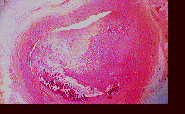
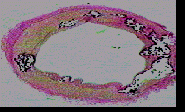
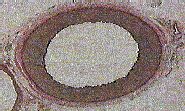
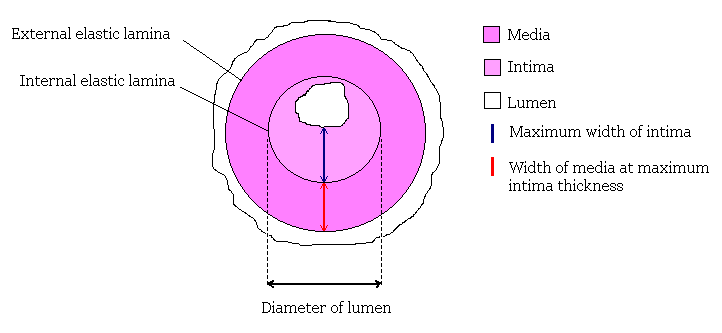
A pathologist can identify various arterial abnormalities by examining cross-sections of the artery under magnification. Below is a figure showing a cross-section of an artery. Normally, the intima rests on the internal elastic lamina; intimal thickening is identified if extra tissue or cells are observed between the intima and the internal elastic lamina. Calcification or hardening of the media can also be noted. Atherosclerosis is indicated by the presence of cholesterol or foamy white blood corpuscles.
The three arterial abnormalities, intimal thickening, medial calcification and atherosclerosis can lead to impaired blood flow through the artery.
Morphometric analysis provides a way of quantifying the degree of intimal thickening and atherosclerosis. The analysis in this study was based on the most severely diseased part of an artery. Morphometric analysis provides a measure of various characteristics of an artery, which are combined to provide indices of disease severity.
The 3 main indices used were
- Percentage of luminal narrowing
- Intimal thickness index.
- Intima-to-media ratio
Higher values of each of these indices indicate more severe disease. Luminal narrowing, intimal thickening and a high intima-to-media ratio mean that blood flow will be impaired.

Article
Ruengsakulrach, P., Sinclair, R., Komeda, M., Raman, J., Gordon, I., & Buxton, B. (1999) Comparative histopathology of radial artery versus internal thoracic artery and risk factors for development of intimal hyperplasia and atherosclerosis. Circulation, 100(19), II-139 – II-144.
Study design
-
- Age in years
- Sex
- Presence of diabetes
- History of cigarette smoking
- Presence of peripheral vascular disease
- Presence of cerebrovascular disease
- Presence of hypercholesterolemia
-
(For details about the histopathology, see Background.)
- Presence of intimal thickening
- Presence of medial calcification or atherosclerosis
- Type of atherosclerosis
-
(For details about the morphometric analysis, see Background.)
- Percentage of luminal narrowing
- Intimal thickness index
- Intima-to-media ratio
-
- Diameter of lumen + intima
- Internal elastic lamina area
- Intimal area
- Medial area
- Width of intima
- Width of media
Statistician’s description of study design
Brian and Lek’s study used a clinical sample and made several measurements on two artery types for the same patients.
Protocol
| Patient selection | From time of study commencement, all eligible CABG patients seen by cardiac surgeons are invited to participate. |
|---|---|
| Informed consent | Research nurse explains purpose of study and surgical procedures involved. If patient agrees to participate, provide with Informed Consent form and ask to sign. Forward Informed Consent form to administration. |
| Patient data collection | Research nurse interviews patient and completes interview schedule. Missing information obtained from patient files when possible. |
| Specimen collection | Collect the discarded segments of RA and ITA grafts from all participating patients. Collect the discarded segments for analysis. |
| Specimen treatment | Fix artery segments in a 4% formaldehyde solution and store for histopathology and morphometric analysis. |
| Histopathology preparation | Prepare multiple transverse slices of each artery, with 5µm sections, in paraffin wax. Record a unique identifier for each artery to ensure the pathologist is blind to the artery source, that is, does not know which type of artery is being examined. |
| Histopathology | Pathologist records the presence of the following arterial abnormalities: intimal thickening; medial calcification; atherosclerosis. Also, record the type of atherosclerosis using the American Heart Association classification of vascular lesions. |
| Morphometric preparation | Exclude specimens that have been distorted in surgery or by histopathology preparation. |
| Morphometric analysis |
Using colour image analysis, measure the following:
Calculate the following:
|
Analysis
Summary
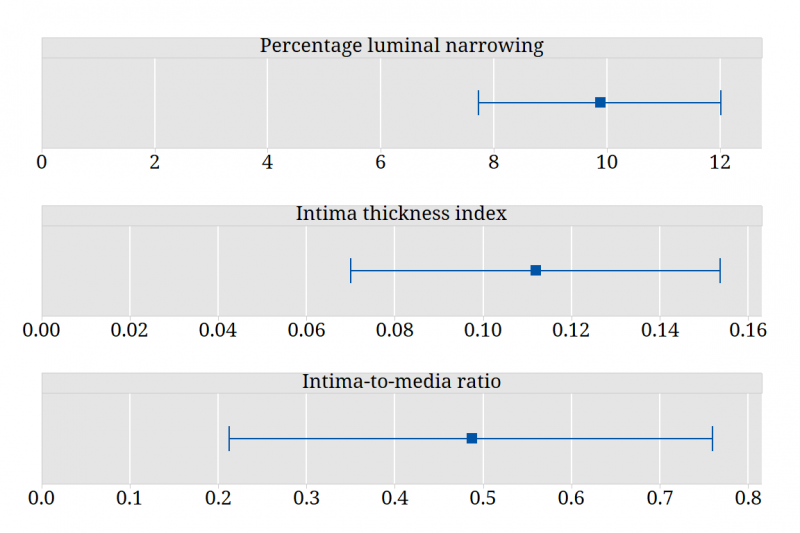
Brian, Lek and their colleagues found that there were more abnormalities in radial arteries (RA) than in internal thoracic arteries (ITA). They also found differences between the arteries for a number of characteristics measured in morphometric analysis. They cautioned that care should be taken in using the radial artery for CABG surgery in some clinical subpopulations.
These figures show estimates and 95% confidence intervals for the mean difference (RA – ITA) for three indices of severity of arterial disease:
Questions to consider
- Produce a summary table to describe the characteristics of the study participants.
- Produce visual displays to describe the results of the morphometric analysis of ITAs and RAs.
- Describe the distribution of each of the three main indices of severity of disease (%LN, ITI, IMR) using appropriate visual displays.
- Compare ITAs and RAs on the three main indices of severity of disease. Summarise your results with a confidence interval.
- Compare ITAs and RAs on the width and area measures obtained from the morphometric analyses. Calculate and plot confidence intervals to summarise your results.
- Which risk factors predict each of the three main indices of severity of disease? Conduct separate analyses for ITAs and RAs.
- Which risk factors predict the arterial abormalities identified by the pathologist? Examine one of the abnormalities and conduct separate analyses for ITAs and RAs.
Definition of variables in data file
| Age | Patient age in years |
|---|---|
| Gender | Sex: 1 = Male, 0 = Female |
| Diabetes | Presence of diabetes mellitus: 0 = no, 1 = yes |
| Ever smoked | History of cigarette smoking: 0 = never, 1 = ever |
| PVD | Presence of Peripheral vascular disease (PVD): 0 = no, 1 = yes |
| CVD | Presence of Cerebrovascular disease (CVD): 0 = no, 1 = yes |
| Hypercholesterolemia | Presence of Hypercholesterolemia: 0 = no, 1 = yes |
| RA intimal abnormality | Radial artery – Intimal abnormalities: 0 = normal, 1 = intimal thickening, 2 = atherosclerosis |
| RA medial calcification | Radial artery – Medial calcification: 0 = no, 1 = yes |
| ITA intimal abnormality | Internal thoracic artery – Intimal abnormalities: 0 = normal, 1 = intimal thickening, 2 = atherosclerosis |
| RA % luminal narrowing | Radial artery – Percentage of luminal narrowing |
| RA Intimal thickness index | Radial artery – Intimal thickness index |
| RA Intima-to-media ratio | Radial artery – Intima-to-media ratio |
| ITA % luminal narrowing | Internal thoracic artery – Percentage of luminal narrowing |
| ITA Intimal thickness index | Internal thoracic artery – Intimal thickness index |
| ITA Intima-to-media ratio | Internal thoracic artery – Intima-to-media ratio |
| RA DLI | Radial artery – Diameter of lumen & intima (mm) |
| RA IEL area | Radial artery – Internal elastic lamina area (mm2) |
| RA Intimal area | Radial artery – Intimal area (mm2) |
| RA Medial area | Radial artery – Medial area (mm2) |
| RA Intimal width | Radial artery – Width of intima (mm) |
| RA Medial width | Radial artery – Width of media (mm) |
| ITA DLI | Internal thoracic artery – Diameter of lumen & intima (mm) |
| ITA IEL area | Internal thoracic artery – Internal elastic lamina area (mm2) |
| ITA Intimal area | Internal thoracic artery – Intimal area (mm2) |
| ITA Medial area | Internal thoracic artery – Medial area (mm2) |
| ITA Intimal width | Internal thoracic artery – Width of intima (mm) |
| ITA Medial width | Internal thoracic artery – Width of media (mm) |
Artery
A relatively thick-walled, muscular tube that carries blood around the body.
Atherosclerosis
degenerative disease of the artery walls, indicated by the presence of cholesterol or foamy white blood corpuscles (see below).
Calcification
A process in which tissue (in this case, the artery walls) becomes hardened as a result of deposits of insoluble salts.
Cerebrovascular disease
Disease of veins and arteries that supply blood to the brain.
Cholesterol
Fat-like substance that circulates in the blood.
Histopathology
The study of abnormal or diseased tissue.
Hypercholesterolemia
High blood cholesterol.
Hypertension
High blood pressure.
Intima
Innermost layer of a blood vessel.
Lumen
A space in the interior of a tubular structure; in this case, the channel in an artery through which the blood flows.
Media
The middle layer of a blood vessel.
Morphometric analysis
The measurement of the form of organisms or their parts.
Patency
A state of being freely open.
Peripheral vascular disease
Any disorder affecting blood flow through veins or arteries that are not close to the heart.